
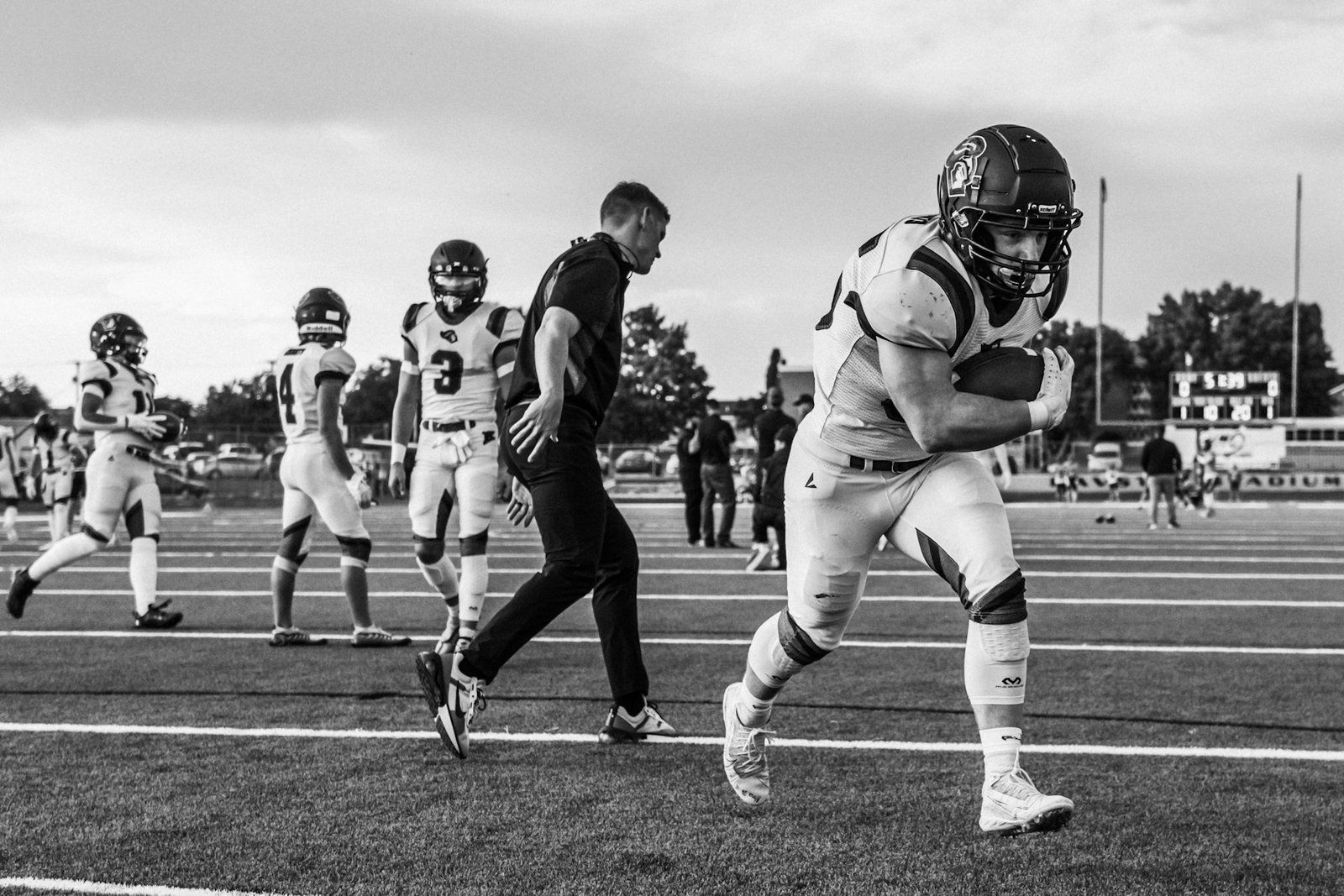
In football, the abbreviation ATH usually stands for athlete. It is commonly used in recruiting profiles for a player whose skills, physical traits, or projected role may fit more than one position. Rather than labeling a prospect only as a quarterback, running back, wide receiver, defensive back, or linebacker, a recruiting service may use ATH when the player has versatility or when the best long-term college position is not yet clear.
ATH is not a special scoring rule, a separate team unit, or a position that appears in the same way on every roster. It is mainly a recruiting and player-evaluation label. A prospect listed as an ATH may eventually play offense, defense, or a role that changes with the team’s scheme. This guide explains the term, why it appears in recruiting rankings, how coaches evaluate athlete prospects, and what players and families should understand when reading a recruiting profile.
What Does ATH Stand for in Football?
ATH stands for athlete. In recruiting, it generally describes a player whose abilities do not fit neatly into one standard position group, or whose likely college role remains open during evaluation. The label can be used for prospects who play multiple positions in high school, show transferable athletic skills, or have a combination of speed, size, strength, and field awareness that could translate to different roles.
For example, a high school player might line up at quarterback on Friday nights, play safety on defense, and return kicks on special teams. A recruiting service may list that prospect as ATH because a college coaching staff could project the player at defensive back, receiver, running back, or another role after evaluating film and physical development.
The meaning is not always identical across recruiting databases. Recruiting services have their own position categories and evaluation criteria. Rivals’ football prospect methodology, for example, explains its Athlete (ATH) category as a group for prospects with genuine positional ambiguity between offense and defense at the college level and beyond. Its explanation is available in the Rivals football prospect rankings methodology.
Why Is a Player Listed as ATH Instead of a Specific Position?
There are several reasons a recruiting profile may use ATH.
1. The player performs well at multiple positions
Some athletes are central to several parts of their high school team. A coach may use the player on offense, defense, and special teams because the athlete has speed, instincts, and enough skill to contribute in more than one area. A single position label may not fully describe the player’s current role or recruiting projection.
2. The player has not settled into a college position
High school systems and college systems do not always use players in the same way. A quarterback who relies on speed and strong open-field decisions may be evaluated as a running back or receiver at the next level. A wide receiver who tackles well and reads routes may also be considered for a defensive role. Coaches may want to see additional development before assigning a final position.
3. The player’s physical development is still underway
Teenage athletes can change in height, weight, speed, strength, and movement skills over several seasons. A prospect who is relatively light at the start of recruiting may project as a defensive back, while later growth could open other possibilities. A recruiting service may keep the profile flexible until there is more information.
4. The athlete has transferable skills
Some traits work across several positions. Acceleration, balance, change of direction, ball tracking, spatial awareness, tackling technique, and decision-making can all be valuable in multiple roles. The ATH label can reflect the fact that a player’s value is not limited to one skill set.
Common Positions an ATH Prospect May Play
An ATH recruit does not automatically play one particular position. The possibilities depend on the prospect’s size, speed, strength, instincts, technical skills, and the needs of the college program.
Wide receiver
A versatile athlete may project to receiver if the player has quick acceleration, reliable hands, route awareness, body control, and the ability to separate from defenders. Film should show how the player tracks the ball, adjusts to throws, and performs against coverage rather than only open-field running.
Running back
A prospect may be evaluated as a running back if the player has vision, balance through contact, acceleration, ball security, and the ability to read blocking. Coaches also consider pass protection and receiving ability, since college running backs may be expected to contribute in more than one phase of the offense.
Defensive back
Speed, footwork, reaction time, change of direction, ball skills, and awareness can make an athlete a candidate for cornerback or safety. A high school player who has experience at quarterback or receiver may still have defensive traits that translate well after coaching and technical development.
Linebacker or hybrid defender
Some athletes have the size, strength, tackling instincts, and movement ability to become linebackers or hybrid defenders. In modern defensive schemes, certain roles may require a player to cover receivers, defend the run, pressure the quarterback, and align in different parts of the formation.
Quarterback or specialist roles
Some ATH prospects remain quarterbacks, particularly when they have a strong passing skill set alongside running ability. Others may contribute as returners or in special packages. The recruiting label does not rule out any one position.
ATH vs. a Standard Football Position
A standard position label communicates a more specific projection. For example, QB identifies quarterback, RB identifies running back, WR identifies wide receiver, CB identifies cornerback, and S identifies safety. ATH communicates that a prospect is being evaluated across more than one possible position or that a final role is still uncertain.
Neither label is automatically better. A clearly projected wide receiver may have a stronger fit at one position than an ATH prospect. A multi-position athlete may have greater flexibility but could also face questions about where the player will develop best. Recruiting decisions depend on the quality of the player, the program’s system, available roster spots, development plan, and other factors.
| Label | Typical meaning | What it tells a recruit or fan |
|---|---|---|
| QB | Quarterback | Primary projection is to play quarterback. |
| RB | Running back | Primary projection is a backfield role. |
| WR | Wide receiver | Primary projection is a pass-catching role. |
| CB | Cornerback | Primary projection is coverage on the defensive perimeter. |
| S | Safety | Primary projection is a deeper defensive coverage role. |
| ATH | Athlete | More than one position is being considered or the projection is still flexible. |
How College Coaches Evaluate an ATH Recruit
Coaches do not recruit an ATH label by itself. They evaluate the athlete’s actual performance and consider how the player may fit their roster. Film is often an important starting point, but it is only part of the evaluation process.
Game film and position-specific skills
Coaches look at full-game or carefully selected film to understand technique, decision-making, consistency, and competition level. A highlight video can show a player’s best moments, but full sequences may reveal blocking, route discipline, defensive alignment, effort away from the ball, and whether a play depended on a teammate’s action.
Speed and movement
Speed can matter at several positions, but straight-line speed is only one part of athletic performance. Coaches may evaluate acceleration, short-area quickness, change of direction, balance, agility, and the ability to maintain speed while handling the ball or reacting to an opponent.
Size and physical projection
Height, weight, reach, strength, and frame can influence where a player may fit. Coaches also consider development potential and whether a prospect can add strength or body mass without losing movement quality. There is no universal size requirement for every position or every scheme.
Football awareness and versatility
Versatility is more than playing several positions. A player must understand assignments, communicate, recognize formations, and execute technique. A prospect who can learn a new role quickly may be attractive to a coaching staff, but development still takes time.
Does ATH Mean the Player Will Play Both Offense and Defense in College?
No. ATH indicates that multiple positions may be under consideration; it does not guarantee that the athlete will play both sides of the ball. College coaches generally choose a primary development path based on the player’s strengths and the team’s needs. Some recruits do play offense and defense, but many eventually focus on one side so they can develop specialized technique and learn the full playbook.
A player may also begin college at one position and move later. A position change can result from growth, skill development, team needs, or a new coaching staff. The ATH label does not lock the recruit into any particular path.
How ATH Appears in Recruiting Rankings
Recruiting services often group prospects into position categories so fans and coaches can compare players with similar projected roles. An ATH category recognizes that some prospects do not fit neatly into a single group. Rankings may still assign an overall rating or national ranking, but position rankings can be presented separately.
Because services use different criteria, one database may list a prospect as ATH while another lists the player as a running back, defensive back, or receiver. This does not necessarily mean one profile is incorrect. The services may be making different projections or may have updated their classifications at different times.
Readers should check the date of a recruiting profile and review the prospect’s recent film, measurements, and college offers. A position label is a summary, not a complete scouting report.
What Should a High School ATH Prospect Include in a Recruiting Profile?
A player being recruited as an athlete can help coaches by presenting a clear, organized profile. Useful items include:
- Accurate height, weight, school, class year, and current contact details for the coach.
- Current game film that shows the player’s strongest positions.
- Clips that demonstrate different skills, such as receiving, open-field running, coverage, tackling, or returns.
- Academic information and relevant test results where required.
- Honest measurements and verified performance data.
- References from high school coaches who can explain the player’s strengths and work habits.
It can help to state which positions the player is most interested in, while also explaining where they are willing to develop. Be specific rather than simply saying “I can play anywhere.” A coach wants to understand what the athlete can contribute and what skills still need improvement.
How Parents and Players Should Interpret an ATH Offer
If a college contacts a player listed as ATH, ask what role the staff is considering. A prospect can ask which position coach would lead development, what technique the staff expects the player to learn, and whether the program anticipates a position change. It is reasonable to ask about the current roster at the intended position and how the team sees the athlete fitting into its scheme.
Families should also understand that a recruiting conversation is not a guarantee of playing time or a permanent position. Coaching staffs change, players develop at different rates, and roster needs can shift. Focus on the quality of the academic fit, coaching relationship, player development, campus environment, and realistic opportunity rather than the label alone.
Frequently Asked Questions
What does ATH mean in football?
ATH means athlete. In recruiting, it is used for prospects who may fit multiple positions or whose college position is not yet clear.
Is ATH an official football position?
It is commonly used as a recruiting category, but it is not a fixed on-field position like quarterback, receiver, or linebacker. Individual teams may use their own terminology for hybrid roles.
Does an ATH recruit play offense or defense?
Either. The player may project to offense, defense, special teams, or a combination, depending on skills and team needs. The label does not guarantee two-way playing time.
Is an ATH recruit better than a four-star receiver or running back?
No label is automatically better. Ratings and projections depend on the player and the recruiting service. A specific-position recruit may have a clear fit, while an ATH prospect may offer a broader skill set.
Can an ATH recruit change positions after joining a college?
Yes. Players sometimes move positions as they develop or as team needs change. The final role is determined by the coaching staff and the athlete’s progress.
Why do recruiting websites list the same player differently?
Recruiting services may evaluate film differently, use different classification rules, or update profiles at different times. One service may project a player at one position while another uses ATH.
Conclusion
In football recruiting, ATH means athlete and signals that a prospect may fit more than one position or has not yet received a firm college projection. It is a useful category for versatile players, but it does not guarantee a specific role, a two-way assignment, or a recruiting advantage. To understand an ATH prospect, look beyond the abbreviation: review game film, physical traits, position-specific skills, development potential, and the way a college program plans to use the player. Those details explain far more than a three-letter label.
